|
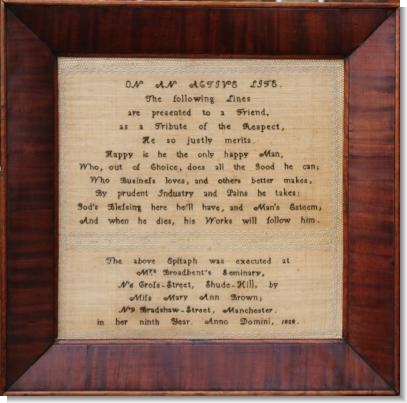
| MARY ANN BROWN, at Mrs BROADBENTS SEMINARY, 1828 |
£450 |
I have never had a school sampler that has lead to the most complete picture of the life and times of its stitcher as this...
Manchester School sampler, worked with the following text 'The following lines are presented to a friend as a tribute of the respect he so justly merits. Happy is he the only happy man, who, our of choice, does all te good he can; who business loves, and others better makes, by prudent industry and pains he takes; God's blessing here he'll have, and man's esteem; and when he dies his works will follow him. The above Epitaph was executed at Mrs Broadbent's Seminary Nr Grofs-Street, Shude-Hill. by Miss Mary Ann Brown; N9 Bradshaw-Street, Manchester in her ninth year Anno Domini 1828',
Mahogany frame, overall 50cm x 50cm.
Now the internet brings up little information on either Mrs. Broadbent or her School, except introducing us to the book, The Manchester Man (1876) by Isabella Banks is a classic Victorian historical novel detailing the rise of Jabez Clegg from a foundling to a prosperous industrialist in 19th-century Manchester. It highlights the city's rapid growth, the Peterloo Massacre, and social changes, often praised for its historical accuracy and vivid portrayal of industrial life including some 62 references to Mrs. Broadbent to quote but a few....
There were at that period in Manchester two schools for101 young ladies, which, being celebrated at the time, deserve to be mentioned. The one was situated at the extreme end of Bradshaw Street, looking through its vista across Shudehill to the gaps in brickwork called Thomas Street and Nicholas Croft, where in highly genteel state Mrs. (or Madame, as she insisted on being called) Broadbent superintended the education of a large and very select circle.
Then she was a wonderful trumpeter of her own fame; made frequent visitations at houses where she was well entertained, and her bombast was listened to for the sake of her young charges; held half-yearly recitations, and also exhibitions of the plain sewing, embroidery, knitting, knotting, filigrees, tambour, and lace work of her pupils; and matrons proud of their own daughters’ achievements seldom paused to reckon up the tears, the headaches, the heartaches, the sore fingers which those minutely-stitched shirts, those fine lace aprons and ruffles, those pictures and samplers had cost. For Madame Broadbent, besides being a martinet rigid in her rule—having a numbered rack for pattens and slippers, numbered pegs for cloaks and hats, book-bags and work-bags, safe-guards (receptacles for sewing, &c., like a huckster’s pocket) and slates, all numbered likewise—was not of too mild a temper, and had a penchant for pinching her pupils’ ears until the blood tinged her nails; and stocks for the feet, backboards for the shoulders, and dry bread diet were her prescriptions for the cure of such delinquencies as an unauthorised word, an omitted curtsey, a bag or garment on the wrong hook, a dropped stitch in knitting, a blotted copy, a puckered seam; and work had to be done and undone until stitches were almost invisible, and little eyes almost blind. She had other peculiarities, had Madame Broadbent—but my portrait is growing too large for its frame, and she was not a large personage at all.
Madame Broadbent’s infallibility being taken for granted, all attempts to make known school troubles and grievances were met with “Never tell tales out of school,”
At length Madame Broadbent, having dismissed ordinary business, rapped her fan upon the table, and in a sharp peremptory tone .
“Sir,—In your advertisement of the new tale by Mrs. Linnæus Banks, about to appear in the pages of your journal, you quote some critiques on ‘The Manchester Man,’ by the same author. One of the characters is true to the very life. Hers was the first school I ever attended, and I have a vivid recollection of the venerable, stately, little dame—a rigid martinet, exacting the utmost deference from all who approached her, and invariably addressed as ‘Madam’ Broadbent. I have often since recalled my feelings of delight when for the first time I went with her and my schoolfellows in great state to the theatre, as described in the novel. She educated the daughters of most of the leading Manchester merchants of that day, the wife of a recent mayor being one of them.
“Madame Broadbent did not profess the innumerable subjects now required, but all that was attempted was well taught. She inculcated habits of the strictest order, neatness, and regularity. The needlework was very beautiful, and would excite astonishment in these sewing machine days. The punishment for talking was very ludicrous. The delinquent was required to sit with her face to the wall—a hideous contrivance of red cloth called the ‘red tongue’ hanging down her back;iv it was considered a great disgrace. She succeeded in teaching a deaf and dumb girl to speak—a feat of which she was justly proud.
“If you think the above remarks on a character well known in Manchester during the early part of the present century are of interest, they are at your service.”
And who was our Mary Ann, it would appear she was born in 1819 to William & Ann Brown she married Joseph Albiston aged 18 in the Manchester Cathedral of St Mary, St Denys & St. George. They had 8 children. She died aged 63 in March 1882. On the 1851 Census she gave her profession as "attends House" .
|
|
|
| |
|

|






 Website By: Red Dragon I.T. Ltd